At State of the Union address on January 31, President Bush has set important agendas for domestic and foreign policy. To begin with, he asserted that the United States should not be wary of global commitment. Despite rampant criticism from antiwar liberals, President’s steadfast attitude to reject isolationism is worth to be appreciated. Also, President Bush demonstrated his enduring quest to prevail democracy and freedom throughout the world, in order to prevent another 9-11 attack and defeat terrorism.
According to Ivo Daalder, Senior Fellow at the Brookings Institution, this is a political strike against opponents on the Iraq issue. Those who call for early withdrawal are labeled defeatists like Neville Chamberlain. While agreeing to US engagement abroad, Daalder raises a question whether this is done by unilateralism or multilateralism (See p.9 ~ p.11 in “Analyzing State of the Union.”).
Also, it is very noteworthy that President Bush declared his unyielding objective for victory in Iraq. Obviously, early withdrawal without completing the mission will invigorate terrorists and ruin coalition efforts since the war broke out. The problem is whether the President has a clear strategy to deal with sectarian conflicts among Iraqis, as insurgents shift their targets from foreign troops to domestic rivals.
This year, the President mentioned repressive and dangerous regimes, including Syria and Burma, Zimbabwe, North Korea, and Iran. Among these states, special focus is on Iran. President Bush accuses Iran of provoking Shiite uprising in Iraq, sponsoring terrorists in Lebanon and Palestine, and developing nuclear weapons. At this stage, the war is not imminent, though the US forces makes preparation for it. This issue will be brought to UN Security Council. Actually, some strong phrases like “the Axis of Evil” or "We will not allow the worst dictatorships or the worst men to possess the worst weapons," were absent.
Finally, let me talk about the most media-focused agenda, “America is addicted to oil.” People are surprised to hear this message because it is commonly believed that the Bush administration is closely associated with oil business. In addition, environmentalists accuse the US of rejecting to ratify the Kyoto Protocol and continue gas-guzzling economy. However, a careful review of America’s foreign and national security policy will tell you that there is nothing strange with this agenda.
America has been committing itself to developing alternative and cleaner energy from national security viewpoints. The Nunn-Lugar Initiative is aimed at reducing weapons of mass destruction and shifting nuclear scientists and technologies for cleaner nuclear energy in Former Soviet Union since 1991. Secretary of Energy Samuel Bodman said that nuclear weapons reduction in Russia would be a great help to cut carbon dioxide emission, at the Carnegie nonproliferation international conference, in which I participated last November.
Russia and Former Soviet states are not the only target for US assistance to convert military use of nuclear technology to peaceful objective. For India, the Bush administration offers technological assistance to stop the gas pipeline project from Iran.
Interestingly, the Atlantic Review points out that Europe is more dependent on Middle Eastern oil than America. Those who criticize the Bush administration’s close ties with oil industries must reconsider their agenda. Whoever the President is, once elected, the person acts as the President of the United States of America. Petty conspiracy theory is meaningless.
In any case, we should not trust pinpoint attacks by anti-American opinion leaders so blindly. Long-term observation, comprehensive understanding, and careful analysis on US foreign and domestic policies are necessary.
For further information, see Edit Copy.
Thursday, February 16, 2006

Sunday, February 12, 2006
New Projects: Special Report on Iran, etc
I will launch a new project to discuss important policy issues in global affairs. To begin with, I will publish special reports on Iran. Professor Kazuo Takahashi of the Open University in Japan says that the Iran issue will be the most critical problem this year. In the special report, I will talk about Iran’s foreign relations with big powers, the United States and EU3 (Britain, France, and Germany), but also Russia, China, Japan, and India. I will mention Iran’s neighbors and non-state actors like terrorist groups as well. I will write about resistance movements by Iranians themselves.
There are following websites of Iranian resistance. They are helpful source of information.
Reza Pahlavi Secretariat
Regime Change Iran (home page)
Regime Change Iran (blog)
National Council of Resistance of Iran
Lion & Sun
Also, I will refer to Japanese opinion leaders as well. Mostly, I have been using American and some European sources. I believe it very important to pick up Japanese opinion. This will be some help for foreigners to understand Japanese perspectives. First, I will write about discussions between Professor Terumasa Nakanishi of Kyoto University and Professor Shoichi Watanabe of Sophia University, which are on historical evaluation of the Anglo-Japanese alliance and lessons for Japanese foreign policy today.
Next post will be on State of the Union address by President George W. Bush.
Monday, February 6, 2006
Sharanky Comments on Palestine Democracy
Natan Sharansky contributed an insightful article, ”The Price of Ignoring Palestinians’ Needs” to the International Herald Tribune on February 1. He is very well known for his book, The Case for Democracy. He will run for the forthcoming election in Israel from the Likud Party. In the article, he argues as follows.
Hamas won the last election because free world, including Israel did not care Palestinian grassroots. This is a natural result. The international community and Israel assisted Palestinian “moderates”, like Yasser Arafat and Mahmoud Abbas with billons of dollars, but marginalized extremists like Hamas. America, Israel and the EU were afraid of pressing too hard for Palestinian reform, because they did not want to weaken the Authority and invigorate Hamas. However, their attitude disillusioned Palestinian people.
To the outside world, Palestinians chose the party of terrorists over the party of peace. But the difference to Israel between Hamas and Fatah does not make much sense. Actually some Fatah satellites, like Tanzim and Al Alsa brigade were responsible for terrorism against Israel. A terrorist like Marwan Barghouti received a lifetime sentence in Israel.
The choice between Fatah and Hamas is the choice between self-absorbed and corrupt terrorists and honest terrorists. Palestinians hope Hamas to eliminate corruption, restore law and order, and implement real reforms. In fact, Hamas chose an election slogan ”Change and Reform,” instead of “Throwing the Jews into the Sea.”
Hamas must satisfy the following two requirements to win support from the international community. First, Hamas must abandon the goal of annihilating Israel, and articulate their position to denounce terrorism. Second, Hamas must dedicate itself to build a free Palestinian society. If they fail to do so, Israel and the free world must confront Hamas. However, as long as they are willing to make efforts for these requirements, we must help them.
The world should not be skeptic to the whole concept of democratic reform in the Middle East, simply because of the result of this election. The election itself does not guarantee democracy. If there is no law and order, and no democratic institution, elections will bring the worst elements of power.
The policy of promoting democracy in the Middle East has not failed. If Palestinians hope for a better future, the free world must help them. Otherwise, the West and Israel will endanger themselves.
What Sharansky said in the article can be applied beyond Palestine. During the Cold War, the United States and Western allies were tolerant to repressive regimes to contain communist threats. The war on terror needs completely different policies. In any case, it is necessary to watch Hamas very carefully.
Monday, January 30, 2006
Free but Undemocratic Russia: Policy Recommendations by a Russian General
Last time I wrote a summary and review of a policy brief on Russia by Anders Åslund, Senior Associate at the Carnegie Endowment for International Peace. He insisted active commitment by the West to promote democracy in Russia and install pro-American regimes in the Former Soviet Union.
In this post, I will introduce another policy brief by Dmitri Trenin, Deputy Director at the Carnegie Endowment Moscow Center. He was a former general of the Russian army, and faculty staff of NATO Defense University.
Just as Anders Åslund, he argues that the West needs to be patient and inclusive to deal with Russia. On the other hand, General Trenin is more cautious of Western intervention into Russian politics. He presents in depth analyses of democracy in Russia. Though he has an elite career in the communist regime, he understands the value of democracy very well as American and European opinion leaders. From now on, I will summarize and review his essay.
In the essay, Trenin insists that Western policy to Russia is confused because of misunderstandings. While the West criticize Putin’s czarist policies, Russians distrust the West. They feel that the West weakens Russia by installing pro-American regimes around their country, channeling Islamic radicals in Chechnya, and ultimately, planning a regime change in Russia itself. Therefore, he says that the West needs better understanding of Russia.
First, this brief examines democracy in Russia. According to Trenin, current Russia is free but not democratic. What does this mean? Russia is free. The parliament is lively, private business can make profits, and the media can criticize the authority. However, Russia is not democratic. The president is the sole decision maker. Capitalism is dependent o the authorities. “Free” media are owned by oligarchs.
The West is critical to Putin’s czarist policy. But in fact, “free but not democratic” trends began in the Yeltsin era, when he enacted first democratic constitution in Russia. Boris Yeltsin was interested in keeping power, but not building democratic institutions. Therefore, democracy did not develop in a free political system.
Then, what is required to make Russia a true democracy? Dmitri Trenin says that Western democracy did not prevail until a self-conscious middle class takes root and flourish. Only successful and sustained development of capitalism can cause this. This process will take a long time in Russia. Also, the bulk of the nation must be above minimal subsistence level in their living standard. Otherwise, he warns, any attempts for democracy will lead to populism.
Currently, Russian politics is managed by self-absorbed elite. In order to move the country toward democracy, it is necessary to establish the baseline of ownership and decision-making. This process itself does not assure democracy, but it is a prerequisite for a constitutional rule of law.
In addition to founding the baseline, the rise of civil society is necessary. Kremlin officials and propagandists like to say the 19th century conundrum that only true European in Russia is the government. Despite such atmosphere, traditional liberalism of intelligentsia takes roots. However, this liberalism is not widespread because it is at odds with patriotism. Today, liberalism in Russia needs to combine freedom with nationalism. New liberalism will emerge from the new bourgeoisie and urban middle class. They will organize themselves beginning from the local level to process demand effectively, and ensure accountability of the authority. Such a new liberalism will appear coarse and anti-intellectual. It will focus on good governance, rather than social justice and human rights. Initiatives by businesspeople will diminish Kremlin’s one-man rule gradually.
General Trenin describes capitalist development and its impact on democratization. Real capitalism in Russia began when Boris Yeltsin adopted the new constitution in 1993, which secures private ownership and business gains. The West accuses Putin of arresting oligarchs. But this is what Russians desired. As long as oligarchs do not get involved in power politics, they are safe. As capitalism develops in Russia, market expands, which provides consumers with more right to choose.
This transition has caused cultural change among Russian people, from collectivism values to private values. In the past, they took pride in their country’s missile forces, ballet companies, and big dam projects. Now, people take pride in their private properties and schools for their children. As a result, the middle class composed of self-conscious individuals is emerging.
In foreign policy, Trenin says that Russian influence on its neighbors is in decline, and Kremlin has neither resource nor will to compete with the West in expanding influence on former Soviet states. Therefore, he argues Russia should liberate itself from imperial burden, and transform as a modern great power. Despite cooling relations with the United States, Russia recognizes American supremacy. Since the West criticizes Kremlin’s Chechnya policy, Russia distrusts America and Europe. Therefore, it is logical for Russia to make a rapprochement with China.
Though Russian importance on the global stage is declining, Trenin insists that this country will not become negligible. The West has immediate interests in energy security and new security threats such as terrorism and WMD proliferation. Russia is an oil and gas exporter to the West. It is a key partner for the US and Europe to deal with Central Asia, Iran, Afghanistan, and Korea.
Finally, Trenin presents the following policy recommendations to the West.
1. Long-term viewpoint: There are no short cuts for democracy.
2. No exclusion: Don’t exclude Russia from G8 and international organizations.
3. Concrete demand: The West must distinguish things they can and they cannot for Russia. Also, make specific demands. For example, instead of a big issue like human rights, the West should demand better treatment for prisoners and professionalism for judges.
4. Contact with grassroots: Never think of king making in Kremlin. More contact with young people will nurture better relations with Russia.
5. Friendly relationship: Don’t treat Russia a “pariah” state just because it is “authoritarian”.
At the end, he advises that the West should stop interventionist policy to Russia, and leave Russians’ business to themselves.
Dmtri Trenin understands essence of Western democracy, and presents in depth analyses of current process in Russia toward democracy. On the other hand, he shows some viewpoints as a Russian, in his skepticism to Western intervention in Russian politics. This essay is quite helpful to understand Russia, and reevaluate democracy in the Western society.
Saturday, January 28, 2006
Palestine Turbulance: Can Terrorists Govern the State?
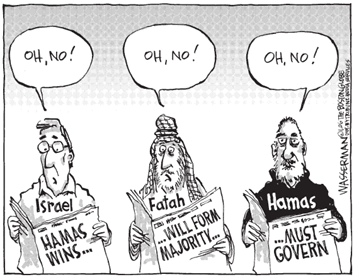
Hamas won the election in Palestine. Can terrorists govern the state?
Israel is surprised to see the result.
Fatah is discouraged.
Hamas is at a loss, becauce they must govern the state!!
Boston Globe, January 27 2006
International Herald Tribune, January 28, 2006
Saturday, January 21, 2006
Brief Review of US-German Talk
Last time, I mentioned that new German chancellor Angela Merkel criticized US treatment against prisoners at Guantánamo naval base. Some people worried that US-German relations would not improve as they had expected just after the election. I argued that the US-German relationship would improve rapidly in my previous post “Bush Foreign Policy: Improving with Europe, Straining with Asia”. I have to admit that this viewpoint was too optimistic. It has become apparent that America and Europe disagree with each other about the balance of counter terrosism and human rights. To understand this perception gap, I would suggest you to read a wellknown book, “Of Paradise and Power: America and Europe in the New World Order.”
How should we evaluate the consequence of Chancellor Merkel’s visit to Washington to talk with President George W. Bush? The Atlantic Review, the bolg I mentioned before, tells as follows.
Most newspapers believe that Chancellor Merkel's warm welcome in Washington D.C. will not lead to a "new transatlantic romance," but to improved, business-like relations based on more hard-headed practicality and reliability. The U.S.-German relationship is expected to be less tainted by populist abuse of political disagreements.The chancellor and the president disagreed on Guantánamo, but agreed on a common approach towards Iran. President Bush did not mention the military option, but stressed UN Security Council negotiations. Chancellor Merkel said that as many countries as possible should be persuaded to ally themselves with the US and Germany and not be intimidated by Iran.
The Atlantic Review concludes the effect of this summit, quoting top media from the US, Britain, and Germany. For detail, please see the link.
Shortly after meeting with President Bush, she visited Moscow to see Russian President Vladimir Putin. Although Iran was the top agenda at the summit, she requested more democracy in Russia as well. Former chancellor Gerhard Schröder was not willing to talk about the latter issue. Chancellor Merkel impressed stark difference from her predecessor.
A chacellor from former East Germany, Merkel is likely to advocate democracy and human rights issues much more enthusiastically than any postwar German chancellors. The centerpiece of German foreign policy will shift from De Gaulle-Adenauer partnership to the transatlantic alliance. However, she will advocate European position that human rights issue cannot be dismissed under the name of war on terror. In any case, Germany will play a key role in transatlantic relations.
Saturday, January 14, 2006
Good News from Iraq: Rebels Divided!
Just briefly, I would like to mention good news from Iraq. According to the International Herald Tribune yesterday (and also, the New York Times), the Islamic Army, an Iraqi insurgence group, decided to fight against Al Qaeda. Qaeda guerillas are Arabs from abroad, and Iraqi rebels are increasingly infuriated to see foreign insurgents kill too many Iraqis. Since October last year, Iraqi rebels and Al Qaeda confront each other.
This split is coinciding with the Sunni Arab’s participation to new political process in Iraq. The Sunnis see foreign militants with resentment. Some Iraqi insurgents, including the Islamic Army and Muhammad’s Army say that they feel happy when US forces kill Al Qaeda members.
After all, people realize what is the beat for Iraq, despite criticism to the United States. Once the regime change begins, no one can stop it. As I mentioned in my previous post, “Pro or Con on American Attack against Iraq before the War”, even war opponent opinion leaders are cooperative to postwar reconstruction. Hoever, some commentators and civic organizations encourage terrorists up-rising through continuing negative campaigns against US-lead operations. They do not assume any responsibility to any damages in Iraq, but simply pursue their satisfaction to promote their leftist agenda. Who’s to be blamed for postwar upheaval? The coalition forces, or terrorists? This is apparent. I wonder why those leftists promote shaming? Had there not been their misbehavior, things would have improved much earlier.
Subscribe to:
Posts (Atom)