This is a year of mid-term election. One of the key focuses is whether liberals can roll back or not. According to the latest CBS/New York Times poll, the approval rate for President Bush has dropped to only 31 %, which is the lowest since he took office. At this stage, 44 % voters say they support Democrats while 33 % of them support Republicans for the mid-term election.
Opinion poll results can change easily. If liberals were to govern the United States, they must show their own policy vision to win real trust from the whole nation. Without this, they end up simply criticizing the current administration.
In 2003, John Podesta, a former chief of staff to Bill Clinton, founded a liberal think tank, called the Center for American Progress (CAP), in order to counterweight major conservative ones like the American Enterprise Institute and the Heritage Foundation. Currently, there are virtually no major think tanks to prevail liberal agendas. The Brookings Institution has strong ties with Democrats, but not so much ideologically-oriented. Moreover, Brookings has joint a project on regulation with the AEI. Most influential policy centers, including the Council on Foreign Relations, the Carnegie Endowment for International Peace, and so forth are nonpartisan or centrist. Some like the Project for New American Century is neoconservative, and the CATO institute is libertarian.
Readers can understand that liberals are not in a good position when it comes to policy making. Actually, Republicans are rated better than Democrats in the war on terror, betting 40 % approval over Democrats’ 35 %. Therefore, it is vital to examine whether liberals can really manage current crisis imposed on the United States and the world.
First, let me review missions of this think tank. Their motto is “Progressive ideas for a strong, just, and free America.” For this objective, the Center for American Progress conduct policy research ranging from domestic, economy, to national security issues.
In foreign policy, they state the following.
We promote the need for a strong, smart military and believe America must safeguard its homeland, fight terrorism and take on threats that know no borders. And we believe America's interests are advanced when we strengthen alliances and work with multilateral institutions that support the rule of law.
Unlike conventional think tanks, they advocate anti-Bush straightforwardly. Also, this think tank is dedicated to public education on a broad range of policy issues. Do they have feasible policy ideas? Last October, CAP published a policy brief, “COMBATING CATASTROPHIC TERROR: A SECURITY STRATEGY FOR THE NATION”, written by top experts including Madeleine K. Albright, former Secretary of State under the Clinton administration. Though this policy brief recommends withdrawal from Iraq, authors do not suggest how to manage this country after that. Quite interestingly, liberal experts share common viewpoints with the current administration that democracy promotion in the Middle East is the key to US foreign policy.
To foresee what happens in America and the world, people should not be so nearsighted to focus solely on election results. Whether Republican or Democrat, winning election is just the means, not the ends. Liberals must persuade the whole nation that they can manage current crisis more effectively. Remember that their approval rate on the war on terror is lower than that of the current administration.
Can liberals deal with critical challenges to America and the globe much better than the current administration? The key to the answer lies in their policy visions. This is the vital reason why people need to keep an eye on this progressive think tank.
Wednesday, May 10, 2006

Sunday, May 7, 2006
The Colossus in Need: America the Peacemaker
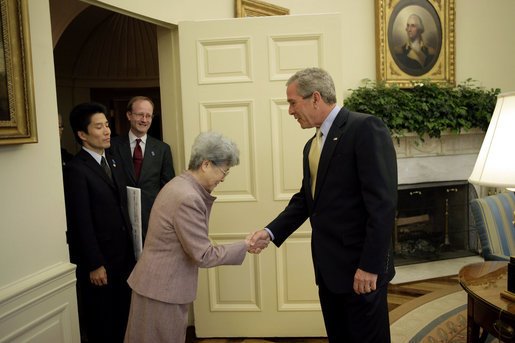 President George W. Bush welcomes Mrs. Sakie Yokota, mother of Megumi Yokota, and her son representing family members of Japanese citizens abducted by North Korea to the Oval Office Friday, April 28, 2006. White House photo by Paul Morse
Those who are critical to US foreign policy need to remember that America is the colossus in need. Since the Iraq War, leftists around the world try to prevail negative images on US leadership, saying that the United States is the greatest threat to world peace. Apparently, this is wrong. The real threats are terrorists and rogue states. Imagine the world without America. Orthodox theory of international politics says US hegemony provides global public goods of liberal world order and democracy.
I have to mention two recent events. See the photo above. President Bush met Sakie Yokota, a mother of Japanese abductee to North Korea on April 28. Her daughter was kidnapped by North Korean agents nearly 30 years ago. It is estimated that hundreds of Japanese are abducted to North Korea. More South Koreans are believed to be abducted by North Korea. The Kim regime use Japanese and South Korean abdustees to train North Korean secret agents. President Bush sent a much clearer message than Japanese and South Korean leaders that he stood firmly against the North Korean autocrat. This has encouraged abductees’ families. (See the video.)
Another event is the Darfur Rally on April 30 in front of the White House. In face of Arab attack against Africans in Darfur, global civil network such as NGOs and bloggers launched a campaign to ask the President to stop genocide in this region. Since Sudan is a member of the Arab league, Arab nations are the most important stakeholders to resolve this issue. Also, the United Nations is expected to play a key role to introduce a peace agreement between Arabs and Africans. However, none of these organizations act sufficiently as a peacemaker. Therefore, bloggers and NGOs regarded a petition to the United States as the last resort.
Two examples indicate that when humanitarian problems come out in the global community, US involvement is vital. Neither international nor regional organizations can intervene effectively, because they do not have enough hard power, nor do they have strong will to bring peace.
In order to understand why American involvement is necessary for world peace and stability, let me review “Still the Colossus” by Robert Kagan, Senior Associate at the Carnegie Endowment for International Peace (Washington Post, January 15, 2006). Despite the rift on Iraq, Europe is willing to cooperate with the United States on Eastern and Central Europe, Afghanistan and Iran. Japan needs US presence to deal with Chinese threats. Why does the world need America so much?
One reason is America’s strength.
The truth is, America retains enormous advantages in the international arena. Its liberal, democratic ideology remains appealing in a world that is more democratic than ever. Its potent economy remains the driving wheel of the international economy. Compared with these powerful forces, the unpopularity of recent actions will prove ephemeral, just as it did after the nadir of American Cold War popularity in the late 1960s and early 1970s.
Another reason I have to mention is international balance of power.
There are also structural reasons why American indispensability can survive even the unpopularity of recent years. The political scientist William Wohlforth argued a decade ago that the American unipolar era is durable not because of any love for the United States but because of the basic structure of the international system. The problem for any nation attempting to balance American power, even in that power's own region, is that long before it becomes strong enough to balance the United States, it may frighten its neighbors into balancing against it. Europe would be the exception to this rule were it increasing its power, but it is not. Both Russia and China face this problem as they attempt to exert greater influence even in their traditional spheres of influence.
Shortly after the fall of Baghdad, global civil movements requested US pressure on Liberia and Burma. Substantial portion of activists blamed US lead war against Iraq. Some of them even condemned the war in Afghanistan, although it was a direct response against 9-11 terrorist attack. I wonder whether they hate or love America. It seems that people all over the world have a mixed feeling to American power. Then, when do they turn toward pro-American or anti-American?
Anti-American sentiments become rampant when people feel overwhelmed by US dominance from culture, politics, and economy to security, and their identity is endangered. This is typical in the Islamic world. Another case is that when people see US foreign policy power-dependent and arrogant. The Iraq War is a notable example. Also, when people associate US image with an authoritarian regime, they turn toward anti-Americanism. In South Korea, the United States sponsored the military regime during the Cold War. This is one of the reasons why anti-Americanism is widespread among South Koreans.
On the other hand, people turn toward pro-Americanism when they face imminent humanitarian challenges, and a petition to the United States appears the last resort. Examples mentioned in this post are such cases. Also, when people are under a repressive government, they become pro-American. Student movements in Iran and the Orange Revolution in Ukraine are typical cases.
In view of such trends, former Secretary of State Henry Kissinger argues that US leadership in the world will be tested whether American predominance turns into international consensus, and American norms are universally accepted. Rome and Britain succeeded in achieving these goals. (“Our Nearsighted World Vision”, Washington Post, January 10, 2000)
Yet, despite this, Kagan says as follows.
The American position in the world has not deteriorated as much as people think. America still "stands alone as the world's indispensable nation," as Clinton so humbly put it in 1997. It can resume an effective leadership role in the world in fairly short order, even during the present administration and certainly after the 2008 election, regardless of which party wins. That is a good thing, because given the growing dangers in the world, the intelligent and effective exercise of America's benevolent global hegemony is as important as ever.
Leftists and global civil societies should bear it in mind.
Wednesday, May 3, 2006
Attention to Darfur
These days, people talk about Iraq, Afghanistan, and Iran. But don’t miss Africa, particularly Darfur. The Atlantic Review and My Newz’n Ideas publishes special issues of Darfur campaigns on both sides of the Atlantic.
An extensive campaign to stop genocide and save residents was held in front of the White House on April 30.
You can join the movement through Bloggers for Darfur and Million Voices for Darfur.
Tony Blair, Paul Wolfovitz, and now, Junichiro Koizumi is getting involved in Africa. You can’t miss it!
An extensive campaign to stop genocide and save residents was held in front of the White House on April 30.
You can join the movement through Bloggers for Darfur and Million Voices for Darfur.
Tony Blair, Paul Wolfovitz, and now, Junichiro Koizumi is getting involved in Africa. You can’t miss it!
Sunday, April 30, 2006
Grading Freedom: Review of Freedom House Index
Today, one of key agendas in US foreign policy is promotion of democracy and freedom. For this purpose, it is necessary to evaluate political processes and civil rights. I decided to write on this issue when I saw a blog debate between Mauo and Mike Ross.
Both are my blog friends. Mauo is a Japanese and believes in JFK liberal policy. On the other hand, Mike has unique backgrounds. He is an American brought up in Kobe, Japan. Though he is a diehard American conservative, he acquired Japanese citizenship a few years ago.
Mauo pointed out that Norimitsu Onishi, Chief of Tokyo Bureau of the New York Times, said that Japan’s politics had been under one-party rule, and its democracy was less developed than those in South Korea and Taiwan, in his article "Why Japan Seems Content to Be Run by One Party" last September. Mike refuted him, saying that the Japanese authority does not interfere civil liberty at all.
Having joined their discussion, I felt it necessary to refer to some objective data to evaluate freedom and democracy around the world. Therefore, I visited the website of Freedom House.
Freedom House is an influential advocacy group, founded by Eleanor Roosevelt to prevail freedom under American leadership. During the Orange Revolution in Ukraine, Freedom House played a core role to organize students’ movement against the regime. The board of trustee is composed of business and labor leaders, former senior government officials, scholars, writers, and journalists. Human rights agendas set by Freedom House are vital in American foreign policy to advance democracy throughout the world. Therefore, it is worth to see how they evaluate freedom in every country.
Freedom House grades the state in 7 levels, from 1 to 7. The smaller the number is, the better in this grading system. The result is shown in the Table of Independent Countries 2005. The best grade is 1-1: 1 in both Political Rights and Civil Liberties. As expected, the following Western democracies mark this grade.
United States, United Kingdom, France, Germany, Denmark, Sweden, Norway, Finland, Netherlands, Belgium, etc
It is quite interesting that many countries in New Europe mark 1-1 as well. They are new democracies, and I wonder whether former communist nations have transformed into free societies so rapidly. In any case, I show you 1-1 countries in New Europe below.
Poland, Estonia, Czech, Slovakia, Slovenia, Hungary
Is Japan really a free country? According to the table, Japan marks 1 in Political Rights, and 2 in Civil Liberties. This is not worse than South Korea, 1-2, and Taiwan, 2-1. Things are not so bad as Onishi says. However, I feel they are graded too highly, because their democracy is less developed than that in the West. A leading Japanologist Karel van Wolfren mentions unaccountable system in Japanese societies in his well-known books like “The Enigma of Japanese Power” and “Keeping the People Ignorant.” From this viewpoint, Freedom House over-evaluates Japan. South Korea needs to be graded much lower, because their police is authoritarian, and anti-American or anti-Jaanese emotionalism dominate its politics.
How does Freedom House evaluate freedom around the world? Their methodology is shown below.
Freedom House does not maintain a culture-bound view of freedom. The methodology of the survey established basic standards that are derived in large measure from the Universal Declaration of Human Rights. These standards apply to all countries and territories, irrespective of geographical location, ethnic or religious composition, or level of economic development.
It is noticeable that some developing countries mark 1-1. Certainly, their grading is fair, and not Western or Anglo Saxon centered. Developing countries mark 1-1 are the following.
Barbados, Cape Verde, Chile, Costa Rica, Cyprus, Dominican Commonwealth, Kiribati, Marshall Islands, Malta, Mauritius, Nauru, Tuvalu, Uruguay
Finally, let me see the grade of countries of critical focus: Iraq, Afghanistan, Iran, North Korea, China, and India. Despite US-lead intervention, both Iraq and Afghanistan are far from free at this stage. As expected, Iran, North Korea, and China mark poor grades. Though the Bush administration sees India a trustworthy democracy to make the controversial nuclear deal, Freedom House grades this country merely 2-3 level: not bad but dangerous to trust too much.
Freedom House Index may not be perfect, but it is apparent that there are no cultural biases in their grading system. More importantly, their evaluation has significant effects on US policymaking. Whether Republican or Democrat administration, promotion of democracy to defeat terrorists and rogue states will be a key agenda of American diplomacy. Therefore, it is strongly recommended to pay attention to this NGO.
Both are my blog friends. Mauo is a Japanese and believes in JFK liberal policy. On the other hand, Mike has unique backgrounds. He is an American brought up in Kobe, Japan. Though he is a diehard American conservative, he acquired Japanese citizenship a few years ago.
Mauo pointed out that Norimitsu Onishi, Chief of Tokyo Bureau of the New York Times, said that Japan’s politics had been under one-party rule, and its democracy was less developed than those in South Korea and Taiwan, in his article "Why Japan Seems Content to Be Run by One Party" last September. Mike refuted him, saying that the Japanese authority does not interfere civil liberty at all.
Having joined their discussion, I felt it necessary to refer to some objective data to evaluate freedom and democracy around the world. Therefore, I visited the website of Freedom House.
Freedom House is an influential advocacy group, founded by Eleanor Roosevelt to prevail freedom under American leadership. During the Orange Revolution in Ukraine, Freedom House played a core role to organize students’ movement against the regime. The board of trustee is composed of business and labor leaders, former senior government officials, scholars, writers, and journalists. Human rights agendas set by Freedom House are vital in American foreign policy to advance democracy throughout the world. Therefore, it is worth to see how they evaluate freedom in every country.
Freedom House grades the state in 7 levels, from 1 to 7. The smaller the number is, the better in this grading system. The result is shown in the Table of Independent Countries 2005. The best grade is 1-1: 1 in both Political Rights and Civil Liberties. As expected, the following Western democracies mark this grade.
United States, United Kingdom, France, Germany, Denmark, Sweden, Norway, Finland, Netherlands, Belgium, etc
It is quite interesting that many countries in New Europe mark 1-1 as well. They are new democracies, and I wonder whether former communist nations have transformed into free societies so rapidly. In any case, I show you 1-1 countries in New Europe below.
Poland, Estonia, Czech, Slovakia, Slovenia, Hungary
Is Japan really a free country? According to the table, Japan marks 1 in Political Rights, and 2 in Civil Liberties. This is not worse than South Korea, 1-2, and Taiwan, 2-1. Things are not so bad as Onishi says. However, I feel they are graded too highly, because their democracy is less developed than that in the West. A leading Japanologist Karel van Wolfren mentions unaccountable system in Japanese societies in his well-known books like “The Enigma of Japanese Power” and “Keeping the People Ignorant.” From this viewpoint, Freedom House over-evaluates Japan. South Korea needs to be graded much lower, because their police is authoritarian, and anti-American or anti-Jaanese emotionalism dominate its politics.
How does Freedom House evaluate freedom around the world? Their methodology is shown below.
Freedom House does not maintain a culture-bound view of freedom. The methodology of the survey established basic standards that are derived in large measure from the Universal Declaration of Human Rights. These standards apply to all countries and territories, irrespective of geographical location, ethnic or religious composition, or level of economic development.
It is noticeable that some developing countries mark 1-1. Certainly, their grading is fair, and not Western or Anglo Saxon centered. Developing countries mark 1-1 are the following.
Barbados, Cape Verde, Chile, Costa Rica, Cyprus, Dominican Commonwealth, Kiribati, Marshall Islands, Malta, Mauritius, Nauru, Tuvalu, Uruguay
Finally, let me see the grade of countries of critical focus: Iraq, Afghanistan, Iran, North Korea, China, and India. Despite US-lead intervention, both Iraq and Afghanistan are far from free at this stage. As expected, Iran, North Korea, and China mark poor grades. Though the Bush administration sees India a trustworthy democracy to make the controversial nuclear deal, Freedom House grades this country merely 2-3 level: not bad but dangerous to trust too much.
Freedom House Index may not be perfect, but it is apparent that there are no cultural biases in their grading system. More importantly, their evaluation has significant effects on US policymaking. Whether Republican or Democrat administration, promotion of democracy to defeat terrorists and rogue states will be a key agenda of American diplomacy. Therefore, it is strongly recommended to pay attention to this NGO.
Thursday, April 20, 2006
Britain Advocates the Victory in Iraq and Afghanistan is a Victory of Global Democracy
British Prime Minister Tony Blair articulated that the victory in Iraq and Afghanistan is vital to prevail democracy throughout the world, and defeat terrorism.
To begin with, let me review Prime Minister Blair’s speech at the Foreign Policy Centre, a New Labour think tank in London. In the speech, Tony Blair presents clear ideas why British and American endeavors in Iraq and Afghanistan are necessary for global democracy. This is a must read to understand the war on terror. (See the video.)
While the majority of Western Europe sees American policy since 9-11 has been a gross overreaction, Blair refutes it a benign inactivity, sitting in the commentator’s seat. Furthermore, the Prime Minister endorses the Anglo-American presence, because Iraq and Afghanistan are facing historical turning point in their struggles for democracy. Tony Blair argues against anti-interventionists as follows.
“The easiest line for any politician seeking office in the West today is to attack American policy. A couple of weeks ago as I was addressing young Slovak students, one got up, denouncing US/UK policy in Iraq, fully bought in to the demonisation of the US, utterly oblivious to the fact that without the US and the liberation of his country, he would have been unable to ask such a question, let alone get an answer to it.”
Moreover, the Prime Minister extends lucid arguments against those who doubt partnership between Al Qaeda and Iran or Iraqi Baathists.
“True the conventional view is that, for example, Iran is hostile to Al Qaida and therefore would never support its activities. But as we know from our own history of conflict, under the pressure of battle, alliances shift and change. Fundamentally, for this ideology, we are the enemy.”
Tony Blair goes on to say “‘We’ is not the West. … but those who believe in religious tolerance, openness to others, to democracy, liberty and human rights administered by secular courts.” Most importantly, the Prime Minister mentions as below.
“[Terrorits] know that if they can succeed either in Iraq or Afghanistan or indeed in Lebanon or anywhere else wanting to go the democratic route, then the choice of a modern democratic future for the Arab or Muslim world is dealt a potentially mortal blow. Likewise if they fail, and those countries become democracies and make progress and, in the case of Iraq, prosper rapidly as it would; then not merely is that a blow against their whole value system; but it is the most effective message possible against their wretched propaganda about America, the West, the rest of the world.”
On his visit to Australia, Prime Minister Blair delivered a similar speech at the Parliament. As Britain and Australia are close partners in Iraq, this address is a reminder to the global community that how important a staunch alliance against terrorists is. (See the video.)
The Prime Minister reiterated the case for British mission in Iraq and Afghanistan.
“To win, we have to win the battle of values, as much as arms. We have to show these are not western still less American or Anglo-Saxon values but values in the common ownership of humanity, universal values that should be the right of the global citizen.”
Tony Blair articulates why a strong alliance lead by the United States is a must for world peace and prosperity as below.
“The danger with America today is not that they are too much involved. The danger is they decide to pull up the drawbridge and disengage. We need them involved. We want them engaged. The reality is that none of the problems that press in on us, can be resolved or even contemplated without them. Our task is to ensure that with them, we do not limit the agenda to security. If our security lies in our values and our values are about justice and fairness as well as freedom from fear, then the agenda must be more than security and the alliance include more than America.”
Shortly after Prime Minister Blair’s tour to Australia, British Foreign Secretary Jack Straw and US Secretary of State Condoleezza Rice made a surprise visit to Iraq on April 3. This shock and impress diplomacy is nothing new. President Bush did it twice, for Iraq and Afghanistan. At the press conference in Baghdad, both secretaries demonstrated their firm commitment to defeat insurgents and eliminate the roots of terrorism in order to bring real democracy in Iraq. Also, both British and American Secretaries said they were in full respect of Iraqi sovereignty and willing to encourage current process to establish new government.
For further understanding of the Blair cabinet’s foreign policy, I would recommend you to read an article, “Think Again” in Foreign Policy, May 2005. According to James G. Forsyth, assistant editor of this journal, Blair is not Bush’s poodle. Blair offers public loyalty in exchange for private influence, but this strategy also requires that he not boast about the achievements. Without Tony Blair’s initiative, George W. Bush would not have requested second resolution at the United Nations on Iraq. Also, without British influence, the United States would not have joined European effort to engage Iran.
In addition, Forsyth says Tony Blair is a neo-conservative in foreign policy. Prime Minister advocates the grand project of commitment to make the world more democratic, and does not hesitate to use force if necessary. Like neoconservatives, Blair believes that nothing happens without American leadership. The Prime Minister pleads with America to stay involved in the world every chance he gets, and not to fall into isolationism. In his 2003 address to a joint session of congress, Blair explained why America must act: “Because destiny put you in this place in history, in this moment in time and the task is yours to do.” Bush’s wordsmiths couldn’t have put it better.
Prime Minister Blair’s speech is an invaluable reminder for the global community. Success in Iraq and Afghanistan will advance democracy and stability throughout the world. It is not servile to be the closest strategic partner to the United States. Rather, keep America engaged with world affairs. A neocon America is much more desirable than an isolationist America.
No other allies are more important than Tony Blair. A slight outsider, the Prime Minister can add more legitimacy to US leadership in the world. None of Secretaries in the Bush administration, from Dick Cheney, Condoleezza Rice, to Donald Rumsfeld have this advantage. There is every reason that the Anglo-American alliance has been the anchor of world peace and stability. My fellow citizens in Europe and Japan, you need to understand this!
Shah Alex
To begin with, let me review Prime Minister Blair’s speech at the Foreign Policy Centre, a New Labour think tank in London. In the speech, Tony Blair presents clear ideas why British and American endeavors in Iraq and Afghanistan are necessary for global democracy. This is a must read to understand the war on terror. (See the video.)
While the majority of Western Europe sees American policy since 9-11 has been a gross overreaction, Blair refutes it a benign inactivity, sitting in the commentator’s seat. Furthermore, the Prime Minister endorses the Anglo-American presence, because Iraq and Afghanistan are facing historical turning point in their struggles for democracy. Tony Blair argues against anti-interventionists as follows.
“The easiest line for any politician seeking office in the West today is to attack American policy. A couple of weeks ago as I was addressing young Slovak students, one got up, denouncing US/UK policy in Iraq, fully bought in to the demonisation of the US, utterly oblivious to the fact that without the US and the liberation of his country, he would have been unable to ask such a question, let alone get an answer to it.”
Moreover, the Prime Minister extends lucid arguments against those who doubt partnership between Al Qaeda and Iran or Iraqi Baathists.
“True the conventional view is that, for example, Iran is hostile to Al Qaida and therefore would never support its activities. But as we know from our own history of conflict, under the pressure of battle, alliances shift and change. Fundamentally, for this ideology, we are the enemy.”
Tony Blair goes on to say “‘We’ is not the West. … but those who believe in religious tolerance, openness to others, to democracy, liberty and human rights administered by secular courts.” Most importantly, the Prime Minister mentions as below.
“[Terrorits] know that if they can succeed either in Iraq or Afghanistan or indeed in Lebanon or anywhere else wanting to go the democratic route, then the choice of a modern democratic future for the Arab or Muslim world is dealt a potentially mortal blow. Likewise if they fail, and those countries become democracies and make progress and, in the case of Iraq, prosper rapidly as it would; then not merely is that a blow against their whole value system; but it is the most effective message possible against their wretched propaganda about America, the West, the rest of the world.”
On his visit to Australia, Prime Minister Blair delivered a similar speech at the Parliament. As Britain and Australia are close partners in Iraq, this address is a reminder to the global community that how important a staunch alliance against terrorists is. (See the video.)
The Prime Minister reiterated the case for British mission in Iraq and Afghanistan.
“To win, we have to win the battle of values, as much as arms. We have to show these are not western still less American or Anglo-Saxon values but values in the common ownership of humanity, universal values that should be the right of the global citizen.”
Tony Blair articulates why a strong alliance lead by the United States is a must for world peace and prosperity as below.
“The danger with America today is not that they are too much involved. The danger is they decide to pull up the drawbridge and disengage. We need them involved. We want them engaged. The reality is that none of the problems that press in on us, can be resolved or even contemplated without them. Our task is to ensure that with them, we do not limit the agenda to security. If our security lies in our values and our values are about justice and fairness as well as freedom from fear, then the agenda must be more than security and the alliance include more than America.”
Shortly after Prime Minister Blair’s tour to Australia, British Foreign Secretary Jack Straw and US Secretary of State Condoleezza Rice made a surprise visit to Iraq on April 3. This shock and impress diplomacy is nothing new. President Bush did it twice, for Iraq and Afghanistan. At the press conference in Baghdad, both secretaries demonstrated their firm commitment to defeat insurgents and eliminate the roots of terrorism in order to bring real democracy in Iraq. Also, both British and American Secretaries said they were in full respect of Iraqi sovereignty and willing to encourage current process to establish new government.
For further understanding of the Blair cabinet’s foreign policy, I would recommend you to read an article, “Think Again” in Foreign Policy, May 2005. According to James G. Forsyth, assistant editor of this journal, Blair is not Bush’s poodle. Blair offers public loyalty in exchange for private influence, but this strategy also requires that he not boast about the achievements. Without Tony Blair’s initiative, George W. Bush would not have requested second resolution at the United Nations on Iraq. Also, without British influence, the United States would not have joined European effort to engage Iran.
In addition, Forsyth says Tony Blair is a neo-conservative in foreign policy. Prime Minister advocates the grand project of commitment to make the world more democratic, and does not hesitate to use force if necessary. Like neoconservatives, Blair believes that nothing happens without American leadership. The Prime Minister pleads with America to stay involved in the world every chance he gets, and not to fall into isolationism. In his 2003 address to a joint session of congress, Blair explained why America must act: “Because destiny put you in this place in history, in this moment in time and the task is yours to do.” Bush’s wordsmiths couldn’t have put it better.
Prime Minister Blair’s speech is an invaluable reminder for the global community. Success in Iraq and Afghanistan will advance democracy and stability throughout the world. It is not servile to be the closest strategic partner to the United States. Rather, keep America engaged with world affairs. A neocon America is much more desirable than an isolationist America.
No other allies are more important than Tony Blair. A slight outsider, the Prime Minister can add more legitimacy to US leadership in the world. None of Secretaries in the Bush administration, from Dick Cheney, Condoleezza Rice, to Donald Rumsfeld have this advantage. There is every reason that the Anglo-American alliance has been the anchor of world peace and stability. My fellow citizens in Europe and Japan, you need to understand this!
Shah Alex
Sunday, April 16, 2006
Test Your Knowledge on the EU
I found an interesting quiz on the website of British Foreign and Commonwealth Office. Questions are very tough. How well can you do?
My score was 6 out of 10. Quite desperate. I thought I knew more about the European Union. Europe is expanding and evolving.
I hope this quiz will stimulate your further interest in European integration.
My score was 6 out of 10. Quite desperate. I thought I knew more about the European Union. Europe is expanding and evolving.
I hope this quiz will stimulate your further interest in European integration.
Wednesday, April 5, 2006
Kissinger talks on India
President Bush’s last visit to Afghanistan, India, and Pakistan is a landmark in US foreign policy. The Indo-American partnership has been strengthened. America demonstrated wholehearted commitment to Afghanistan. On the other hand, relative importance of Pakistan seems to be declining. Though one month has passed since then, India is an important issue in Washington.
In order to understand the overall view of this issue, let me refer to an article, “Anatomy of Partnership” in the International Herald Tribune by Henry Kissinger. In the article, he welcomes new partnership with this powerful English-speaking democracy and the United States. America and India faces common threats of Islamic terrorism. Since 9-11, the US-Indian partnership has become critically important to defeat radical Muslims from Yemen to Mumbai. Also, it is necessary to incorporate India into the global economy. Globalization brings costs and benefits, and both India and the United States can overcome these problems by joint efforts.
On the other hand, while Indian participation in building a new world order will be an advantage to American global strategy, Kissinger warns not to use India as America’s diplomatic card against China and other actors. He argues that neither India nor China seeks pre-eminence in Eurasian heartland, despite conflicts over Tibet. According to Kissinger, both the United States and India need constructive relationship with China, and it does not serve America’s interest to use India to contain China.
The most vital issue is the nuclear deal. Kissinger insists that nuclear progress in India is irreversible, but it is necessary to make Indian commitment to non-proliferation explicit. R. Nicholas Burns, Under Secretary of State, says almost the same thing in the lecture at the Heritage Foundation.
So far as pro-con debates on US-Indian deals are concerned, the most serious issue is nuclear non-proliferation. Should the United States trust India, without considering effects on current non-proliferation regime?
Pro-Indian opinion leaders regard India as a trustworthy democracy. In their view, a feasible agreement outside present NPT will be helpful foe nuclear arms control.
Robert Kagan, Senior Associate at the Carnegie Endowment for International Peace, says that a powerful and prosperous democracy like India is a good counterbalance against China and Russia. Most importantly, he endorses US double standard policy against Iran and India, because Iran takes brinkmanship diplomacy while India does not. While he recognizes current NPT regime remains a useful tool to stop nuclear proliferation, he insists that realistic deals with India are inevitable as this regime is collapsing.
His viewpoints are widely shared among neoconservatives and Bush administration supporters. Helle Dale, Director of the Douglas and Sarah Allison Center for Foreign Policy Studies at the Heritage Foundation, goes on to say that arguments against India sound rather like the District of Columbia's gun laws, which leave handguns in the hands of the criminals, but deny honest citizens the right to own one.
IAEA welcomes this deal as well. Considering icy relations between American conservatives and UN bureaucrats, it is a surprise. Though India refuses to sign NPT, Director General Mohammed El Baradei supports the deal to bring India closer as an important partner in the non-proliferation regime while satisfying its growing energy needs. It is noteworthy that R. Nicholas Burns told Reuters that this unique deal with India would not be repeated with other countries such as neighbor and rival Pakistan, because India has not proliferated for 30 years. He says this distinguishes India from major proliferators like North Korea.
Still, some opinion leaders worry that the Bush administration gave too much benefits to India without sufficient return. According to Joseph Cirincione, Director of Nonproliferation Project at the Carnegie Endowment for International Peace, President Bush permitted the Indian authority to decide which reactors would be exempted from inspection. This does not satisfy the normal and full-scope inspections originally sought. Moreover, he warns that a double standard will undermine US effort against Iran.
Even Republican leaders including Senator Richard Lugar, Chairman of the Senate Foreign Relations Committee, Rep. Henry Hyde, Chairman of the House International Relations Committee, and Rep. Ed Royce, Chairman of the Subcommittee on International Terrorism and Nonproliferation worry that the deal is too lenient for India, and sacrifice nonproliferation objectives.
As India is buying uranium from Russia before the US-Indian deal comes into effect, opponents’ views are worth being considered.
In face of these pro-con debates, George Perkovich, Vice President at the Carnegie Endowment for International Peace, says that nonproliferation rules needs to change flexible enough to get India in. However he worries that the deal is too vague and too fast. The term of “civilian” and “military” must be defined more strictly, he says. Though Perkovich does not necessarily agree to President Bush’s approach, he defends a double standard.
“Iran has been found noncompliant with legal obligations, and is being held to account for them. Also, Iran, unlike India, does not recognize the right of some countries to exist. Iran, unlike India, conducts terrorism...The two examples are very different.”
Finally, let me review Afghanistan and Pakistan just briefly. For the surprise visit to Afghanistan, President Bush canceled the tour to Taj Mahal. Unlike former president Bill Clinton, he did not enjoy tiger safari in India. These facts illustrate how serious the Bush administration is to resolve Afghan issues. On the other hand, the importance of Pakistan to the United States is declining. It is noticeable in Burns’ lecture at the Heritage Foundation. He mentions too much on India, and too little on Pakistan.
Fundamentally, the Bush administration is right to incorporate India into the global economy, and establish strategic partnership with this powerful English-speaking democracy. But remember that India acts on its own. America should not trust this country blindly. Former senator Sam Nunn who currently chairs the Nuclear Threat Initiative raises serious concern that the deal will damage US interest without imposing sufficient obligations to India. Pro-con controversies at the congress will be intensified. Forthcoming debates will be a real landmark in US foreign policy and global nonproliferation.
by Shah Alex
In order to understand the overall view of this issue, let me refer to an article, “Anatomy of Partnership” in the International Herald Tribune by Henry Kissinger. In the article, he welcomes new partnership with this powerful English-speaking democracy and the United States. America and India faces common threats of Islamic terrorism. Since 9-11, the US-Indian partnership has become critically important to defeat radical Muslims from Yemen to Mumbai. Also, it is necessary to incorporate India into the global economy. Globalization brings costs and benefits, and both India and the United States can overcome these problems by joint efforts.
On the other hand, while Indian participation in building a new world order will be an advantage to American global strategy, Kissinger warns not to use India as America’s diplomatic card against China and other actors. He argues that neither India nor China seeks pre-eminence in Eurasian heartland, despite conflicts over Tibet. According to Kissinger, both the United States and India need constructive relationship with China, and it does not serve America’s interest to use India to contain China.
The most vital issue is the nuclear deal. Kissinger insists that nuclear progress in India is irreversible, but it is necessary to make Indian commitment to non-proliferation explicit. R. Nicholas Burns, Under Secretary of State, says almost the same thing in the lecture at the Heritage Foundation.
So far as pro-con debates on US-Indian deals are concerned, the most serious issue is nuclear non-proliferation. Should the United States trust India, without considering effects on current non-proliferation regime?
Pro-Indian opinion leaders regard India as a trustworthy democracy. In their view, a feasible agreement outside present NPT will be helpful foe nuclear arms control.
Robert Kagan, Senior Associate at the Carnegie Endowment for International Peace, says that a powerful and prosperous democracy like India is a good counterbalance against China and Russia. Most importantly, he endorses US double standard policy against Iran and India, because Iran takes brinkmanship diplomacy while India does not. While he recognizes current NPT regime remains a useful tool to stop nuclear proliferation, he insists that realistic deals with India are inevitable as this regime is collapsing.
His viewpoints are widely shared among neoconservatives and Bush administration supporters. Helle Dale, Director of the Douglas and Sarah Allison Center for Foreign Policy Studies at the Heritage Foundation, goes on to say that arguments against India sound rather like the District of Columbia's gun laws, which leave handguns in the hands of the criminals, but deny honest citizens the right to own one.
IAEA welcomes this deal as well. Considering icy relations between American conservatives and UN bureaucrats, it is a surprise. Though India refuses to sign NPT, Director General Mohammed El Baradei supports the deal to bring India closer as an important partner in the non-proliferation regime while satisfying its growing energy needs. It is noteworthy that R. Nicholas Burns told Reuters that this unique deal with India would not be repeated with other countries such as neighbor and rival Pakistan, because India has not proliferated for 30 years. He says this distinguishes India from major proliferators like North Korea.
Still, some opinion leaders worry that the Bush administration gave too much benefits to India without sufficient return. According to Joseph Cirincione, Director of Nonproliferation Project at the Carnegie Endowment for International Peace, President Bush permitted the Indian authority to decide which reactors would be exempted from inspection. This does not satisfy the normal and full-scope inspections originally sought. Moreover, he warns that a double standard will undermine US effort against Iran.
Even Republican leaders including Senator Richard Lugar, Chairman of the Senate Foreign Relations Committee, Rep. Henry Hyde, Chairman of the House International Relations Committee, and Rep. Ed Royce, Chairman of the Subcommittee on International Terrorism and Nonproliferation worry that the deal is too lenient for India, and sacrifice nonproliferation objectives.
As India is buying uranium from Russia before the US-Indian deal comes into effect, opponents’ views are worth being considered.
In face of these pro-con debates, George Perkovich, Vice President at the Carnegie Endowment for International Peace, says that nonproliferation rules needs to change flexible enough to get India in. However he worries that the deal is too vague and too fast. The term of “civilian” and “military” must be defined more strictly, he says. Though Perkovich does not necessarily agree to President Bush’s approach, he defends a double standard.
“Iran has been found noncompliant with legal obligations, and is being held to account for them. Also, Iran, unlike India, does not recognize the right of some countries to exist. Iran, unlike India, conducts terrorism...The two examples are very different.”
Finally, let me review Afghanistan and Pakistan just briefly. For the surprise visit to Afghanistan, President Bush canceled the tour to Taj Mahal. Unlike former president Bill Clinton, he did not enjoy tiger safari in India. These facts illustrate how serious the Bush administration is to resolve Afghan issues. On the other hand, the importance of Pakistan to the United States is declining. It is noticeable in Burns’ lecture at the Heritage Foundation. He mentions too much on India, and too little on Pakistan.
Fundamentally, the Bush administration is right to incorporate India into the global economy, and establish strategic partnership with this powerful English-speaking democracy. But remember that India acts on its own. America should not trust this country blindly. Former senator Sam Nunn who currently chairs the Nuclear Threat Initiative raises serious concern that the deal will damage US interest without imposing sufficient obligations to India. Pro-con controversies at the congress will be intensified. Forthcoming debates will be a real landmark in US foreign policy and global nonproliferation.
by Shah Alex
Subscribe to:
Posts (Atom)